Introduction to Qualitative and Spatial Research Methods
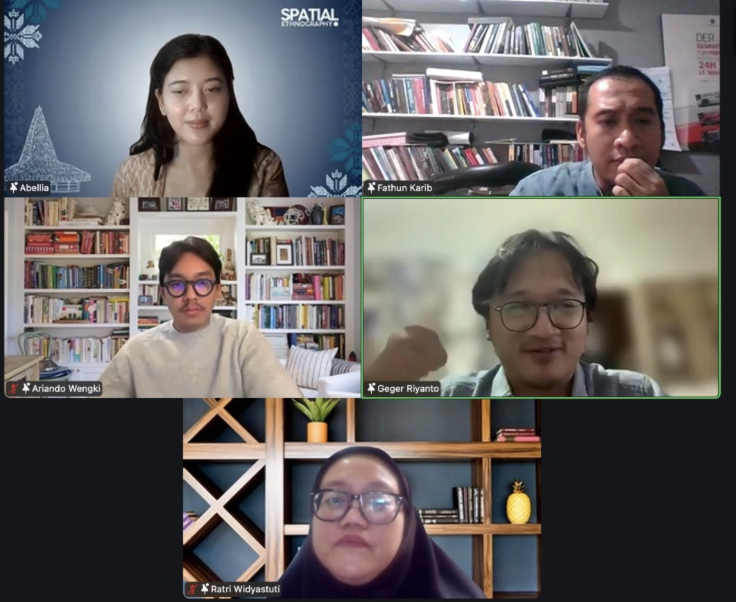
Mini Course 2026 online launch attended by participants
14 Maret 2026
The Spatial Ethnography research group successfully conducted the inaugural session of its Mini Course series titled “Introduction to Qualitative and Spatial Research Methods” on Saturday (14/3). This discussion served as a vital platform for disseminating an integrative methodology that bridges anthropological, sociological, and geospatial perspectives to better understand the complexities of communal living spaces.
The session commenced with a presentation by Dr. Geger Riyanto from Universitas Indonesia, who underscored the necessity for researchers to remain critical of spatial simplification. He introduced the concept of dwelling space (lived space), noting that field realities often stand in stark contrast to “abstract space” or the normative maps designed by authorities. “Ethnography must capture the immersive texture of social life, ensuring we don’t fall prey to the idealized imagery in our own minds,” Dr. Geger remarked.
Continuing the dialogue, Dr. Fathun Karib from the National University of Singapore (NUS) presented the assemblage (relational) approach. Through a case study of the agrarian conflict in Porong, Sidoarjo, he demonstrated how oral history can be utilized to reconstruct social transformations preserved within the collective memory of residents, which are subsequently integrated into global spatial data.
From a maritime perspective, Dr. Wengki Ariando from KITLV Leiden introduced the concept of Aquapelagos. He challenged the prevailing land-centric paradigm that has historically dominated research in Indonesia. Dr. Wengki emphasized that for sea nomadic communities such as the Bajo people, the ocean is not a void. Instead, it is a landscape saturated with human history and defined by fluid territories.
In the concluding presentation, Dr. Ratri Widyastuti from Institut Teknologi Bandung illustrated how geospatial technology (GIS) breathes life into raw coordinate data by integrating attribute information. She asserted that digital mapping transcends mere millimeter-perfect positioning on paper. Rather, it focuses on how these data points narrate human activities and facilitate targeted policy-making.
Moderated by Dr. Abellia Anggi Wardani, the discussion transitioned into interactive breakout rooms. Participants from diverse academic backgrounds engaged in direct dialogue with the experts to refine their respective research plans.
This inaugural session successfully demonstrated that space is far from a passive geographical backdrop. Instead, it is a dynamic arena rich with meaning. Through a synthesis of anthropological and sociological theories alongside geospatial technology, the discussion provided a fundamental foundation for researchers, academics, and practitioners to view social reality more holistically. It is a point of convergence where technical data precision meets the profound depth of human stories.
Written by: Adjie Arya Putra – Media Intern Spatial Ethnography
 Spatial Ethnography
Leave a comment