
Reconsidering Modernity and Tradition: A Mini Course on Economic Structural Shifts and Spatial Theory
4 April 2026
The dynamic tension between traditional systems and modernity once again took center stage in the third session of the mini course series organized by Spatial Ethnography. Carrying the theme “Modernity, Tradition, and Spatial Theory,” this session examined transformations in local economic structures and their impact on people’s lived spaces through a spatial ethnography approach.
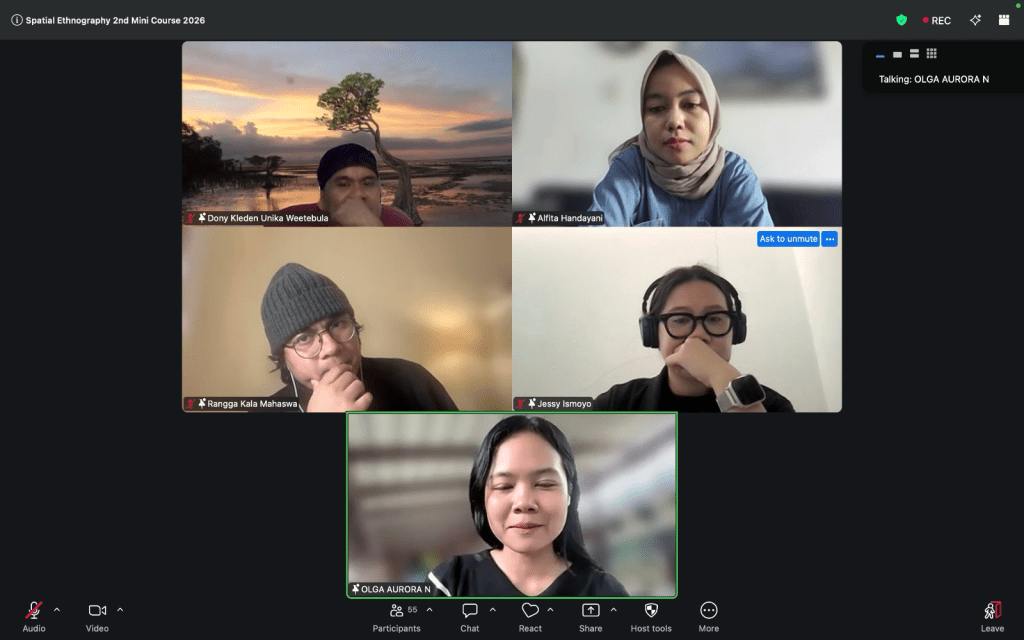
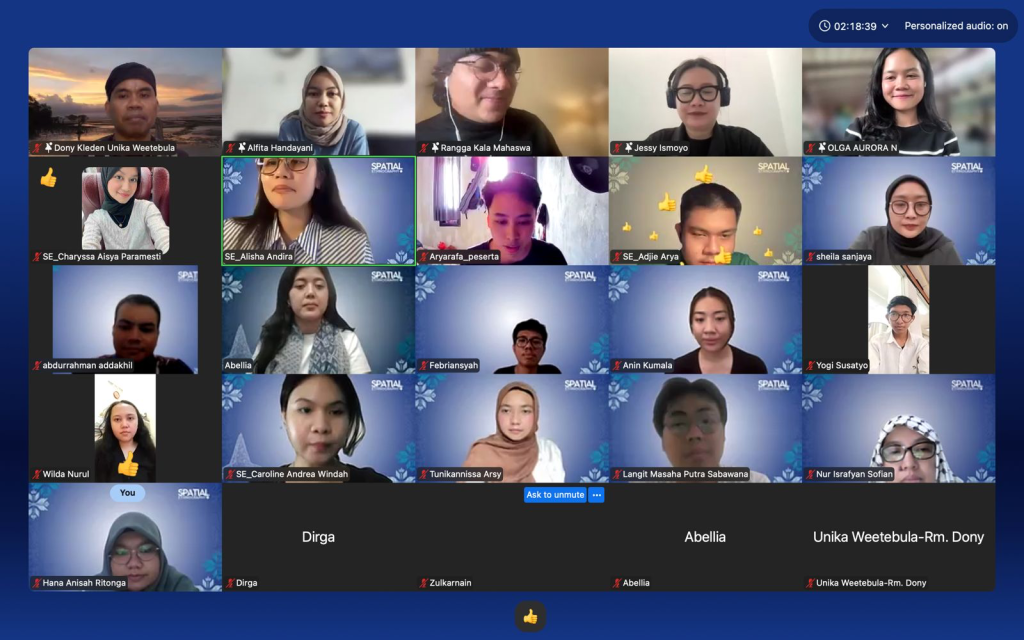
Mini Course Series 3 examines the Shift in Economic Structure and Spatial Theory
The session specifically highlighted the transition from customary resource-based economies to fixed monthly income systems. This shift was identified as a key driver of fundamental changes in consumption patterns, household financial management, and the resilience of local food systems.
The discussion opened with a presentation by Konradus Doni Kelen, S.S., M.A. from Universitas Katolik Weetebula, who offered field-based insights into the interaction between Marapu beliefs and evolving settlement patterns in Southwest Sumba. He explained how modern infrastructure increasingly prompts negotiations with traditional spatial arrangements, which were once centered around customary houses and megalithic tombs.
The session continued with Dr. Petsy Jessy Ismoyo, S.Hum., M.Si. from Universitas Kristen Satya Wacana (UKSW), who explored human and cultural dimensions through the study of Bissu rituals in South Sulawesi. She emphasized that rituals function as spatial practices and “hybrid spaces,” serving both as sites of identity preservation and resistance for marginalized groups within shifting sacred landscapes.
Next, Rangga Kala Mahaswa, S.Fil., M.Phil., a doctoral candidate at the University of Glasgow, presented a philosophical perspective on “Spatial Circulation.” He invited participants to reflect on how economic value extends beyond price, operating instead as an abstract social relation that drives capital and reshapes how communities perceive their living spaces.
Closing the session, Dr. Alfita Puspa Handayani from Institut Teknologi Bandung (ITB) examined these transformations through spatial mapping techniques. She demonstrated how economic indicators such as industrial growth and infrastructure access visually reconstruct the “lived space” of communities.
The session provided a deep analysis of local economic restructuring, particularly how dependence on fixed income is reshaping societal perceptions of time and labor compared to traditional agrarian systems. These changes have direct implications for food sovereignty, as communities shift from self-sustained resource use toward reliance on global markets and external food systems. More broadly, the discussion applied spatial theory to analyze how modernity redefines the boundaries of customary territories and public spaces amid increasing capitalist pressures.
Following the presentations, participants engaged in interactive breakout room discussions. These smaller group settings allowed for direct dialogue with speakers, the exchange of case studies, and deeper critical engagement with the material. The discussions fostered a dynamic and personal exchange of ideas among participants from diverse backgrounds.
This mini course program aims to serve as a platform for academics, practitioners, and students to collaboratively formulate solutions to the ongoing challenges of balancing the preservation of traditional values with the demands of modern economic systems.
Written by: Charyssa Aisya Paramesti- Media Intern Spatial Ethnography


Leave a Reply